
The 425 Sqdn left from Dishforth at 1943-03-01 at 18:05
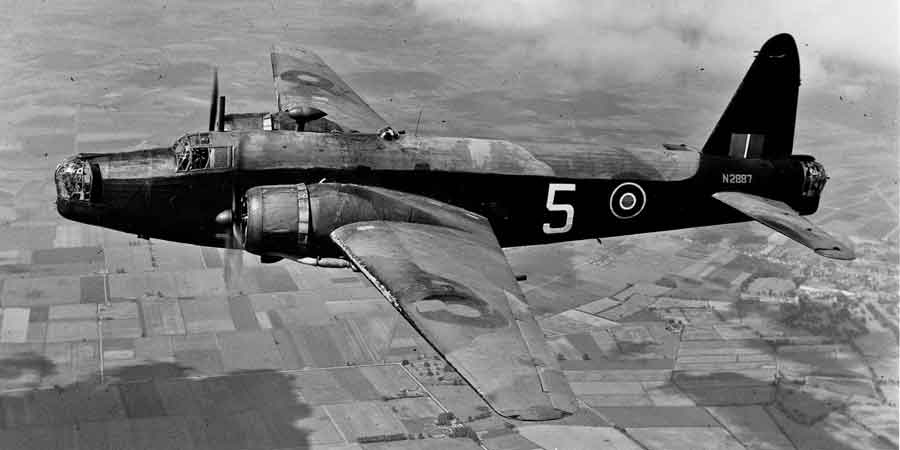
He flew with a Vickers Wellington (type III, serial BJ918, code KW-F).
Campaign report of the USAAF:
No report
Campaign report of the RAF:
28 February/1 March 1943
Having destroyed Lorient, Bomber Command was now ready to start on the second target on the list of French U-boat base ports - St Nazaire - which the directive of 14 January had ordered to be destroyed. 437 aircraft - 152 Lancasters, 119 Wellingtons, 100 Halifaxes, 62 Stirlings, 4 Mosquitos - were dispatched. 5 aircraft - 2 Lancasters, 2 Wellingtons, 1 Stirling - were lost, 1.1 per cent of the force.
This initial raid caused widespread destruction. Local reports say that many bombs fell into the port area and that 60 per cent of the town was destroyed. 29 people are reported as being killed and 12 injured; it is presumed that most of the local population had left the town.
3 Mosquitos to the Ruhr, 5 Wellingtons minelaying off St Nazaire, 2 OTU sorties. No losses.
1/2 March 1943
302 aircraft - 156 Lancasters, 86 Halifaxes, 60 Stirlings despatched to Berlin.
The Pathfinders experienced difficulty in producing concentrated marking because individual parts of the extensive built-up city area of Berlin could not be distinguished on the H2S screens. Bombing photographs showed that the attack was spread over more than 100 square miles with the main emphasis in the south-west of the city. However, because larger numbers of aircraft were now being used and because those aircraft were now carrying a greater average bomb load, the proportion of the force which did hit Berlin caused more damage than any previous raid to this target. This type of result - with significant damage still being caused by only partially successful attacks - was becoming a regular feature of Bomber Command raids. Some bombs hit the Telefunken works at which the H2S set taken from the Stirling shot down near Rotterdam was being reassembled. The set was completely destroyed in the bombing but a Halifax of 35 Squadron with an almost intact set crashed in Holland on this night and the Germans were able to resume their research into H2S immediately. 17 aircraft - 7 Lancasters, 6 Halifaxes, 4 Stirlings - lost, 5.6 per cent of the force.
6 Mosquitos to the Ruhr, 49 Wellingtons and Halifaxes minelaying off French and German coasts, 4 OTU sorties. 2 Wellington minelayers lost.
With thanks to the RAF and USAAF.net!
This record can also be found on the maps of WW2 History Europe with Google coordinates. You can find the maps by clicking on this link on this location.
There are several possibilities to investigate the flight records on WW2 History Europe. All the flights are plotted on maps, sorted "day by day", "by squadron", "by type aircraft", "by year or month", "by location" and much more! Don't miss this!!!
If you have any information that you want to share, please add your comment at the bottom of this record. Or send your information to
Your photos and your information are very welcome! The young do care and with your help we keep up the good work.

